Tuesday, 13 September 2016

Legal Information Assess Centre (LIAC) @ your library


The FAMILY LAW handbook

Copies of the latest The family law handbook : your practical guide to Australian family law (4th edition) have arrived at Campbelltown and Ingleburn libraries in the Reference collections. 

These are for use only in the library however Chapter 1 (The family law system) and Chapter 2 (Marriage, de facto relationships, separation and divorce) are available online via the Legal Information Access Centre website:
www.legalanswers.sl.nsw.gov.au/guides/family_law_handbook/index.html


 The family law handbook is a practical guide for people undergoing separation and divorce. It includes information on what to do when separating, how to negotiate with your former partner, making arrangements for your children, family violence and abuse, achieving a fair property settlement and what happens in court. It includes sample forms, tips on drafting an affidavit, strategies for preparing for a court hearing and useful information on all aspects of the separation and divorce process.

Please note: Readers are advised to seek expert legal advice with specific problems in family law. This book is intended as a guide to the law and should not be used as a substitute for legal or accounting advice.

Tuesday, 26 July 2016

Month before the HSC

The library's HSC programme has a variety of free lectures and workshops that take place throughout the year.

Our next talk Month before the HSC is presented by Rowan Kunz, the CEO of Smart Education who was extremely successful in his own HSC and was named one of Australia's 'Top 30 under 30 Entrepreneurs'.

This is a free workshop that will be held at HJ Daley Library on Wednesday 24 August from 5.30pm – 7.00pm.

Wednesday, 6 July 2016

Issues in Society


The library receives a subscription of Issues in Society for each branch. There is a copy in the HSC collection for loan and at H J Daley Library we also have a copy in Reference so that one is always available to you.

Each book in the series has fantastic up to date information, facts and statistics from a huge range of primary and secondary sources.

Spinney Press is the publisher of these titles, on the companies website they say, "Information in each 'Issues in Society' title is carefully selected to ensure that it is current, unbiased and balanced. Many titles cover a range of opinions on controversial topics, providing the perfect platform to provoke debate, stimulate critical analysis and encourage further research."

There is an amazing range of topics with fantastic information for your assignments. Make sure to check out Issues in Society for your next assignment. They can be located in the Reference and HSC collections under the call number 360 ISS.

Wednesday, 18 May 2016

HSC English Area of Study: Discovery

The library's HSC programme has a variety of free lectures and workshops that take place throughout the year.

Our next talk HSC English Area of Study: Discovery is presented by Larry Grumley who is a HSC exam marker and has been an English teacher for over 25 years.

This is a free session that will be held at Eagle Vale Library on Thursday 23 June from 5.30pm – 7.00pm.


Monday, 7 March 2016

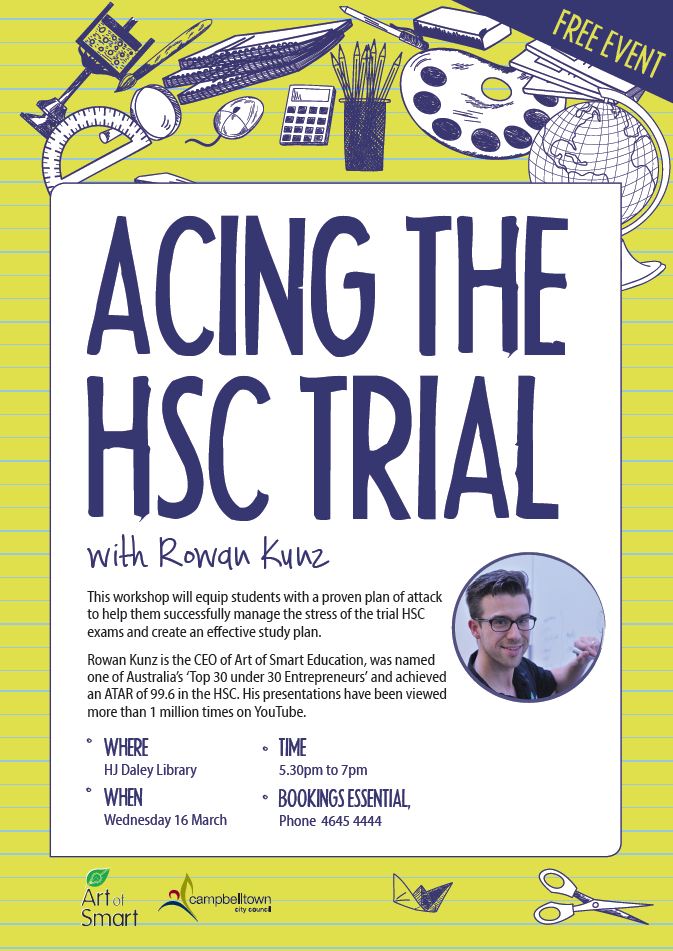
Acing the HSC Trial

The library's HSC programme has a variety of free lectures and workshops that take place throughout the year.

Our next talk Acing the HSC Trial is presented by Rowan Kunz, the CEO of Smart Education who was extremely successful in his own HSC and was named one of Australia's 'Top 30 under 30 Entrepreneurs'.

This is a free session that will be held at HJ Daley Library on Wednesday 16 March from 5.30pm – 7.00pm.


Thursday, 3 March 2016

Mungo Man

These footprints of the Willandra people discovered in 2003 are 20,000 years old.

The remains discovered at Lake Mungo in 1974 are possibly the most significant archaeological find in Australian history and are the oldest modern human remains found in Australia to date.  

The discovery revealed one of the world's oldest known cremations. This finding gave support to the theory that complicated burial rituals existed in early human societies. It also proved that Aboriginal people were present in Australia 20,000 years earlier than previously recorded.

There are a few keywords that could help you find information in your search; these include:
  •  Mungo
  •  Mungo Man
  •  Archaeology Australia
  •  Willandra Lakes
  •  Willandra Archaeology
Try some of the above terms in the library online catalogue; we have some great physical resources on this discovery.

If you go to the Information desk online webpage on the Library website you will see that you have access to encyclopaedias like World Book and Britannica which will also contain some information about the area.


Some websites you might find useful

This website is filled with fantastic information about the park; including the amazing archaeological finds there.

The Willandra Lakes region is listed as a World HeritageSite. This website contains important information about the region and its history.

This site has information about Mungo National Park. This includes information about the area, flora and fauna that is found in the area and the numerous ongoing conservation programs taking place in the park.


Wednesday, 10 February 2016

How to help your teen through the HSC

The library's HSC programme has a variety of free lectures and workshops that take place throughout the year.

Our first talk is; How to Help Your Teen through the HSC: a session for parents and carers of Year 11 and 12 students.

This is a free session that will be held at HJ Daley Library on Tuesday 1 March from 6.30pm – 7.30pm.


Friday, 5 February 2016

Hot topics at your library


Hot Topics update


LIAC (Legal Information Access Centre) State Library of NSW has recently updated their Hot Topics collection, removing any irrelevant copies and retaining current easy-to-read topics.
Fourteen topics are available in print at each branch (in Reference and HSC collections) as laws are constantly changing and being reviewed, new topics and updated issues will only be available online however ALL issues can be viewed online:
http://www.legalanswers.sl.nsw.gov.au/hot_topics/index.html

Topics covered include Domestic violence, First Australians, Human rights, Voting and elections, Consumer law, Families, International humanitarian law, Australian legal system, Discrimination, Animal law, Consumer credit, International law, Indigenous law, Prisoners, You and your lawyer and Drugs and the law.


Friday, 20 November 2015

Musicians & bands


Fuel was scarce in France during World War I. You had to be very rich to obtain coal to heat your home. Debussy, offered to pay his coal merchant with an original composition. The merchant went home with Debussy’s last composition, appropriately named “Evenings Lighted by Burning Coals.”
When you are asked to do an assignment on a musician or band there are years and years of musical history you could choose an artist from. Do exercise caution whilst researching because there will be a lot of misleading information out there.
When searching, a good place to start would be to use the artist or band name you have chosen.

When looking at books avoid any titles with the words “unauthorized” or “unofficial” in the title, the facts in titles like these have not necessarily been checked thoroughly.
If you are looking at online material look for biographies on the official artist page. Do not trust information that is not from reliable sources and certainly do not look at magazine or newspaper articles.

If the artist you are researching is older and therefore does not have an ‘official’ website, for example French composer Claude Debussy, you could look him up in an encyclopaedia like Britannica or World Book.

If you are looking at online sites that look like legitimate biography websites make sure to check who created the website. There are some websites out there that advertise as biography sites, but are created by magazines or television networks. Instead try the library’s Reference Databases Biography in Context.

Friday, 13 November 2015

Art – Painting & Painters


Fun fact: 'Le Bateau' by Henri Matisse hung upside-down for 47 days in the Museum of Modern Art in New York until a patron realised the mistake.
 
The art of painting goes back thousands and thousands of years which is why this topic area is so vast.
Your first step is to have a look at what your question is asking for. Once you have figured out what the question is asking you about painting you will be able to put together some search terms. See below for some suggestions you could start with.

If you are being asked about painting mediums you could try words such as watercolour, oil, spray paint and acrylic. If the question is about syles of painting you should consider keywords like surrealism, impressionism and abstract.

You could also be asked about the history of painting or painters of a specific region or country. For that kind of question I would recommend using keyword combinations like ‘Painting Africa’ (you could also add in the word ‘history’).

If you are looking for information on a specific painter/artist I would recommend searching using their name, an example would be ‘Leonardo da Vinci’. If you want to know about a specific painting again I would recommend starting by using the name of the art like ‘Mona Lisa’. Also consider that there might me alternative terms you could use, for example whilst ‘Mona Lisa’ is the most commonly used spelling for this artwork you might also find some information under the spelling ‘Monna Lisa’.

Try some of the above terms in the library online catalogue; we have some great information on art, particularly in our reference section.

If you go to the Information desk online webpage on the Library website you will see that you have access to encyclopaedias like World Book and Britannica. These resources will be great for collection information.

The library’s Reference Databases webpage has some great databases you could search in too. A good one for finding information on artists is Biography in Context.

Some websites you might find useful
Encyclopedia  of Art 
This website has some really interesting and extensive information that could be useful to you.  

This page is part of the scholastic website which is great and has a lot of information on the history of painting going back to cave paintings in a number of cultures.  

This is an online magazine that has some amazing information on artists and pieces of art as well as art history.

Tuesday, 27 October 2015

World Heritage Sites


Uluru is estimated to be 600 million years old.

A World Heritage Site is a place (such as a building, city, complex, desert, forest, island, lake, monument, or mountain) that has been deemed as being of cultural or historical significance. These sites are examined by the United Nations Educational, Scientific and Cultural Organization (UNESCO) and if found suitable are included in the list of World Heritage Sites.
There are a few keywords that could help you find information in your search; these include:
·         World Heritage
·         World Heritage site/s
·         International World Heritage Programme
·         UNESCO

If you want to find information about a specific world heritage site then you should use the name of the site as your search term, also think about alternate names for the site. For example ‘Ayers Rock’ is also known as ‘Uluru’.
Try some of the above terms in the library online catalogue; we have some great physical resource on world heritage sites.

If you go to the Information desk online webpage on the Library website you will see that you have access to encyclopaedias like World Book and Britannica. These resources will have information on world heritage sites.

Some websites you might find useful
UnescoWorld Heritage List
This is the actual World Heritage Site list. If you are in doubt as to whether the area you want to research for your assignment is classified as world heritage you should definitely check out this page. If you then click on the site you are interested in it will provide you with some information on the site.

This has some great information specific to Australian heritage sites. The list of Australian sites is here if you click on one of the options it will provide you additional information. The 'Heritage' page is a good resource also.

This site has some spectacular images of the sites and some good information too. Great for some history and background information.

Friday, 9 October 2015

Incas


The Incan Empire was the largest empire in pre-Columbian America. There is a lot of information about the history of the Incan Empire and we are going to look at the best ways to find it.
There are a few keywords that could help you find information in your search; these include:
·         Inca

·         Incan Empire

·         Ancient Americas

·         History Peru
If you are looking for more specific information you need to use specific terms. For example if you wanted information on a particular area you might use the name for that area; like, ‘Machu Picchu’ or ‘Cusco’ or 'Cuzco'. If you wanted to know about things like religion, cuisine or war I would suggest adding those terms after the word ‘Inca’ or ‘Incan’. We have some fantastic physical resources in the library you can look at.

If you go to the Information desk online webpage on the Library website you will see that you have access to encyclopaedias like World Book and Britannica. In fact there is some great information on the Incan people on the Britannica website. http://www.britannica.com/topic/Inca
If you then go to the Reference Databases webpage try using the word “Inca” to search in the databases Ancient and Medieval History and Modern World History, these have some great information.

Some websites you might find useful
Gold and the Incas http://nga.gov.au/Exhibition/Incas/
This is the webpage related to an exhibition at the National Gallery of Australia. It has some fascinating artefacts and information. Make sure you click the ‘Learn more’ button to access the full information and catalogue for this exhibition.

The page Incas from the British Museum also has some great information. http://www.britishmuseum.org/explore/cultures/the_americas/incas.aspx
The Incas http://www.latinamericanstudies.org/incas/collier.htm This page has some fantastic historical information about the Incan Empire.

The Inca Empire http://mysite.du.edu/~ajenniso/IncaEmpire.html
This website has some interesting historical information on the people as well as some of the places.


Saturday, 26 September 2015

Higher School Certificate (HSC)


Are you currently studying for the NSW Higher School Certificate (HSC)? There are many things that can help you prepare for your examinations.
The Library has a great range of HSC resources such as the Excel textbooks. A quick search in the catalogue using the word “excel” and adding onto the end the subject you are studying such as “excel history” will bring up the items for you. These books are very popular, but if the copy you can borrow is out you might want to check to see if there is a copy in the reference collection. You can’t take this copy home with you, but you can use it in the library and take photocopies from it.

You may also like to check out our HSC student resources web page which has some great information to help you prepare for your exams.
I would also recommend going through the NSW HSC Online website, this site has information on every subject for the HSC and is an invaluable resource.

Another great way to study and prepare is to practice. Did you know that the Board of Studies, Teaching and Educational Standards of NSW has past HSC examination papers on their website? Not only do they have past papers, they also have the marking guidelines and the notes from the markers for each paper. Click the link to check out the examination papers from 2014. These papers are in PDF format so you are able to print copies out to use. Think about trying the past papers and timing yourself as if you were in the exam.


Friday, 18 September 2015

Can I use that website?


The internet is amazing; it is full of fantastic information that will help you with assignments. However, not all of the information you find on the internet is correct. You need to be able to work out what information is reliable and therefore suitable to use in assignments.
There are a number of ways you can decide whether an online source is credible, I like to ask myself the following questions:

Who wrote it?
Check who has written the content. You might find this information on the ‘About us’ page of the website, the author might be an individual, a group or an organisation. Hopefully they will also include information on the author’s credentials, for instance if you are reading an article on literacy programs in primary schools and the author has a master’s degree in education then they have appropriate expertise on the subject they are writing about. If you cannot find any information about who wrote the website then you should be wary about using any information on the website.

What kind of website is it?
The above image shows how to break down a URL to tell what kind of organisation created the website. Below you will see how to identify what the organisation part of a website address means. If a website is commercial then you can expect that the information on the site will be geared towards trying to get you to purchase something or agree with something they have said. Organisation (.org) website can often be very useful, the Beyond Blue website is a .org website www.beyondblue.org.au and is a great source of information and tools. However you still need to be careful about who created the website, make sure the information is accurate, some organisation websites will not be as good as Beyond Blue.
As a general rule I would concentrate on aiming to use websites that are government, education or academic websites with some organisation websites where appropriate. If you are ever in doubt ask your teacher, I’m sure they will be able to help you.

Types of websites you may come across


Is the information biased?
Information can be presented in certain ways with the aim of convincing the reader of something. For example if you were reading a website about the effect of pesticides on our food that was written by a company that sells pesticides you would find that more than likely the chemicals would be discussed in a positive manner. This website therefore would not be suitable to use for an assignment.

Is the information accurate?
Is it written in appropriate language without spelling mistakes? Does the information provide facts or statistics? If so then are you able to check the sources of these statistics to ensure they are accurate.

Is the information current?
How recent is the information in the website? For many subjects you don’t want to look at information that is more than 5 years old when you are looking at online resources unless the information is of historical significance to the subject of your assignment.

Friday, 4 September 2015

Amazing Australians: Fred Hollows

Image source: www.hollows.org.au
Fred Hollows was a New Zealand and Australian ophthalmologist, it is estimated that more than 1 million people can see today as a direct result of Fred Hollows work. Fred strived to provide eye care for the underprivileged and poor, and to improve the health of indigenous Australians. He also travelled overseas to underprivileged areas and organised training programs to train technicians in eye surgery. The Fred Hollows foundation was founded in Australia in 1992 to carry on his work when he passed.  

Fred is an amazing Australian and information on him is relatively easy to find, but be sure that the information you are gathering is from reputable sources.

In the Library & on the Library website
Searching the catalogue using the keywords “Fred Hollows” will get you some good results.

If you go to the Information desk online webpage on the Library website you will see that you have access to encyclopaedias like World Book which has information on Fred Hollows.

If you then go to the Reference Databases webpage try using the name “Fred Hollows” to search in Biography in Context which will give you some great information.

Online
If you decide to Google once again you can use the name Fred Hollows, other terms you could try include Fred Hollows Foundation.


Other websites that you might find useful
Fred Hollows Foundation
This foundation was set up in 1992 to continue the work of Fred Hollows following his death in 1993. It contains some great information about Fred and his work.

Australian Stories: Fred Hollows
In 1990 Fred Hollows was awarded the title ‘Australian of the Year’, this page provides a brief biography as well as links to related information.

This page contains great information about Fred as well as pictures of items from the Fred Hollows collection at the National Museum of Australia. It even contains a map which shows the movements of National Trachoma and Eye Health Program teams from 1976 to 1978 as well as some interesting links to related information.

Friday, 28 August 2015

Cardiovascular disease


Cardiovascular disease (CVD) is a group of diseases that affect the heart or blood vessels and it is currently the leading cause of death in Australia.
There are a number of ways you could choose to look for information about cardiovascular disease, but first you should think about the search terms you will use. Following are some suggested search terms you should consider using for your search:
·         Heart disease – this is the most commonly used term for cardiovascular disease.

·         CVD – this is the acronym for cardiovascular disease.
You could also try looking for specific heart diseases such as;
·         Cardiomyopathy – diseases of cardiac muscle

·         Heart failure

·         Pulmonary heart disease – failure on the right side of the heart.

·         Congenital heart disease – heart structure abnormalities that exist from birth.

·         Myocardial infarction – this is also known as a ‘heart attack’ (another great term you could use).
As you can see there are many options for search terms to do with heart diseases and if you like you can try them all. If you look up the Wikipedia article on ‘cardiovascular disease’ you will find a number of other great search terms to use, do remember that Wikipedia isn’t a reliable source though so you should not rely on it for your assignments.

In the Library& on the Library website
When searching the Library catalogue you will get more results using the search term “heart disease” than if you use “cardiovascular disease”. You could also find information about these diseases by looking in health books, if you have any problems finding material please ask one of the staff for assistance.
If you go to the Information desk online site you can use encyclopaedias like Britannica and World Book to access information using the keywords discussed above.  

If you then go to the Reference Databases webpage you could using the keyword suggestions we have discussed above to search in the Science Reference Center database, Academic Search Premier and Consumer Health Complete.

Online & websites that you might find useful
If you decide that Google is the way to go think about your search terms, “cardiovascular disease” because it is a more clinical term will get you higher quality results. It will also get you results from all over the world (even if you go to Google.com.au), if you want specific information about cardiovascular disease in Australian then you must put the word “Australia” somewhere in your search term.

Check out some of the websites below that are reliable sources with great information:

Cardiovascular disease This website is fantastic, it is written by the Australian Government Department of Health and not only has information about a number of heart diseases, it also gives information on treatments, has information on programmes and activities to support prevention and optimal detection and treatment and also has some amazing related links.
Australia'shealth 2014
Australia’s health 2014 is the 14th biennial health report of the Australian Institute of Health and Welfare. This resource contains information and statistics on the all areas to do with the health of Australians. There is a free PDF available of the report from this page.

Data and Statistics
This page is written by the Heart Foundation and has some seriously important information that will be very valuable to your research. It contains a lot of data and statistics about a variety of things related to heart disease such as the prevalence of heart disease in each state, facts and figures specifically related to Australia and links to a number of fact sheets.

Heart Disease – Australian Bureau of Statistics The Australian Bureau of Statistics is a very reliable source of data, it has some great information on heart disease and includes links to some other very valuable websites you can check out.

Friday, 7 August 2015

The Human Body


Fun fact: When you are sleeping your ears continue to pick up sound but your brain blocks them out.
The human body is an amazing and complex thing, doctor’s study for many years to get a good understanding of the human body and how it works as well as how to treat its ailments.
There is a lot of information available about human anatomy and we are going to explore some of the ways you can access it.

A good place to get started is to do some general reading about the body; this will give you a good knowledge base to start off with and will help you choose keywords for your information search.
Try keywords like:
·         Human body

·         Human anatomy

·         Human physiology
If your assignment is on the human body in general, then the keywords above will provide you with a great amount of information.

If you need more information on a specific area of the body then you need to be specific in the search terms you choose. For instance, a book on ‘human anatomy’ might have a paragraph or two about the lungs, but if your whole assignment is on lungs then you will need more information than this. Use the specific area of the body as your search term, try:
·         Lungs

·         Heart

·         Nervous system OR human brain

·         Digestive system

In the Library & on the Library website
Searching the catalogue using the keywords discussed above will find you some great print resources to work from.

If you go to the Information desk online webpage on the Library website you can use encyclopaedias like Britannica and World Book to access information using the keywords above. 

If you then go to the ReferenceDatabases webpage try using the keyword suggestions we have discussed above to search in the Consumer Health Complete databases which contains a lot of information on all areas of health. If you are looking for something specific, such as conditions that affect the heart then perhaps try something like ‘cardiovascular disease’. 
 
Online & websites that you might find useful

If you decide to look for information online, do be careful because there is a lot of information available on the web and you need to make sure that the source of the website is reliable. One great way you can decide if a website it reliable is to look at who created it and ask yourself whether the person or group that created it would be experts in this area. Have a look at some of the below websites to get an idea of what sites you can use.

This website was created by the American Medical Association so you know that the site was made by people who have knowledge and expertise about the human anatomy. The site has some great information about many areas of the human body and even includes some information about disorders.

This website was developed by the science section of National Geographic. It has some great information and even interactive sections like this page on lungs
Fun fact: Coughing can cause air to move through your windpipe faster than the speed of sound.


This website is aimed at a younger audience and is written by a gentleman with a degree who has a lot of experience in the area of Science. It is a great resource with a lot of interactive areas to enjoy and learn from.

This is a great article that talks about all the areas of the human anatomy, it also contains links to provide you with more information about each area. If you scroll to the bottom of the page you can see that the woman that wrote the article holds a number of degrees including a Master of Science in biology which means she is well qualified to be educating others on the body.